
Author — Habib Nooh
1. Waves of White Tents:
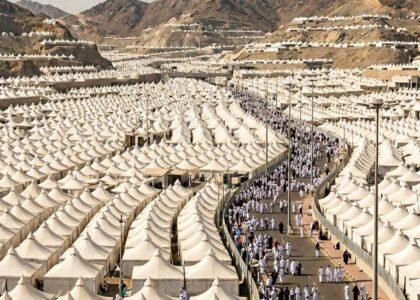
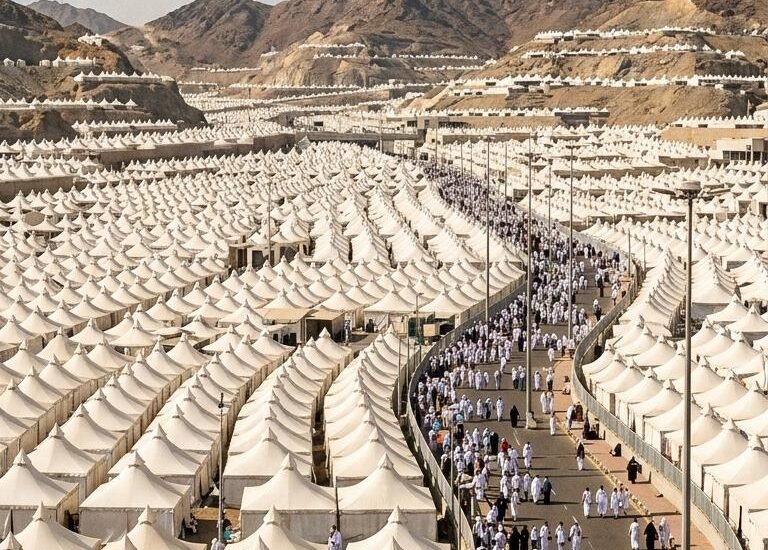
Today is the 8th of Dhul‑Hijjah. The quiet, mountain‑embraced valley has come alive once more. Pilgrims have begun to settle here—the formal beginning of Hajj starts from this very place. All around, rows upon rows of white tents rise like vast waves of a silent sea. This is Mina—the heartland of Hajj.
Mina is the valley where the essential rites of Hajj unfold. Situated between Arafah, Muzdalifah and Makkah, this sacred stretch awakens each year with the arrival of millions of Muslims.
Seen from afar, Mina resembles a serene white ocean—each wave a tent resting at the foot of the mountains. Standing in this valley, one feels as though it is not people, but worship itself that flows like waves across the land.
2. A Sea of Humanity:
Mina spans nearly 20 square kilometres. It lies about 8 kilometres east of the Sacred Mosque in Makkah, stretching along the route to Arafah. Mountains surround it on all sides, and in the middle flows a sea of humanity.
When night descends, the tents glow with light— as though the stars have fallen gently upon the valley. In the night breeze, the scent of duʿa, Takbeer and tears mingles softly. Roads, security, medical care—everything is present, yet the true beauty of Mina lies in its quiet, devotional atmosphere.
During the days of Hajj, Mina becomes the most densely populated temporary city on earth. For the stay of countless pilgrims, it transforms into what the world calls the “Tent City.”
3. The White City:
More than one hundred thousand white tents stand here. Each is fire‑resistant, air‑conditioned and arranged with remarkable order. Every tent is like a small dwelling—electricity, water and security all provided. Pilgrims are grouped by country, each block neatly organised.
By day, the sun; by night, the lights; and at all times, the sound of Takbeer. Cool air flows inside the tents, while outside the movement of people continues— yet above everything rests a profound tranquillity, a peace found only in the air of Mina.
One cannot truly grasp how a valley becomes a city of worship until one sees this vast white landscape. It stands like a great field of devotion, clothed in the white garment of sacrifice.
4. Bound by One Identity:
The history of Mina is marked by the footsteps of prophets. Here, Ibrahim (AS) cast stones at the whisperings of Shaytan. Here, the Prophet Muhammad (PBUH) stayed during his Farewell Hajj—teaching the Companions, offering sacrifice, and performing the rites of Ramy.
Mina is like an open page of sacred history— where every pilgrim writes his name in the ink of worship. Its inhabitants share one identity: Muslim, traveller, one who trusts in his Lord.
Here, a person forgets every other label and remembers only this— that he is a servant, and Allah is his Lord.
5. Mina in the Qur’an:
Allah says: وَٱذْكُرُواْ ٱللَّهَ فِىٓ أَيَّامٍ مَّعْدُودَٲتٍ
“And remember Allah during the appointed days.” —Surah Al‑Baqarah 2:203
These are the days of Mina— the days of Ayyam al‑Tashreeq (10th–12th Dhul‑Hijjah)— a time and place dedicated to proclaiming the greatness of Allah.
6. Mina in the Hadith:
The Prophet (PBUH) performed Ramy at the Jamatat in Mina— the symbolic stoning of Shaytan (Bukhari 1751).
He travelled from Muzdalifah to Mina with calm composure (Nasa’i 3061).
In Mina, he taught the Companions the rulings of Hajj (Muslim 1297).
Mina is therefore not merely a location— it is a living classroom of the Sunnah.
7. Pilgrims in Mina:
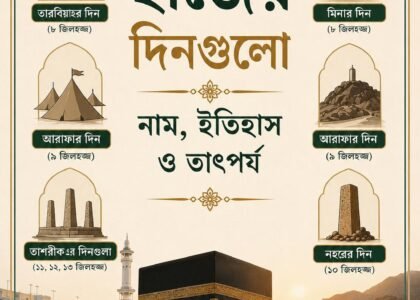
On the morning of the 8th of Dhul‑Hijjah, pilgrims arrive in Mina. They perform the five daily prayers there and spend the night. After Fajr on the 9th, they depart for Arafah. On the 10th, they return to Mina. They remain there on the 10th, 11th and 12th— and, if needed, the 13th—performing Ramy each day.
The principal rites of Mina— Ramy, sacrifice, shaving or trimming the hair, the Takbeer of Tashreeq, and spending the nights— all symbolise devotion, remembrance and surrender. Each day in Mina becomes a new step in the pilgrim’s journey of purification.
8. A Symbolic Struggle:
Mina is not merely a valley— it is a city of purification, sacrifice and sacred memory. Here, pilgrims follow the legacy of the prophets, wage a symbolic battle against Shaytan, and offer themselves to the nearness of Allah.
This Tent City teaches us every year that the true beauty of Hajj lies in worship, patience, discipline and sacrifice. And every year, Mina seems to whisper—
“Forget your colour, your race, your language. Here, you are only a servant— and He is your Lord.”