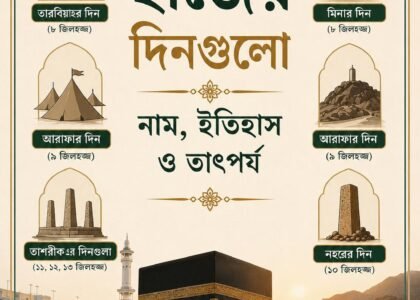

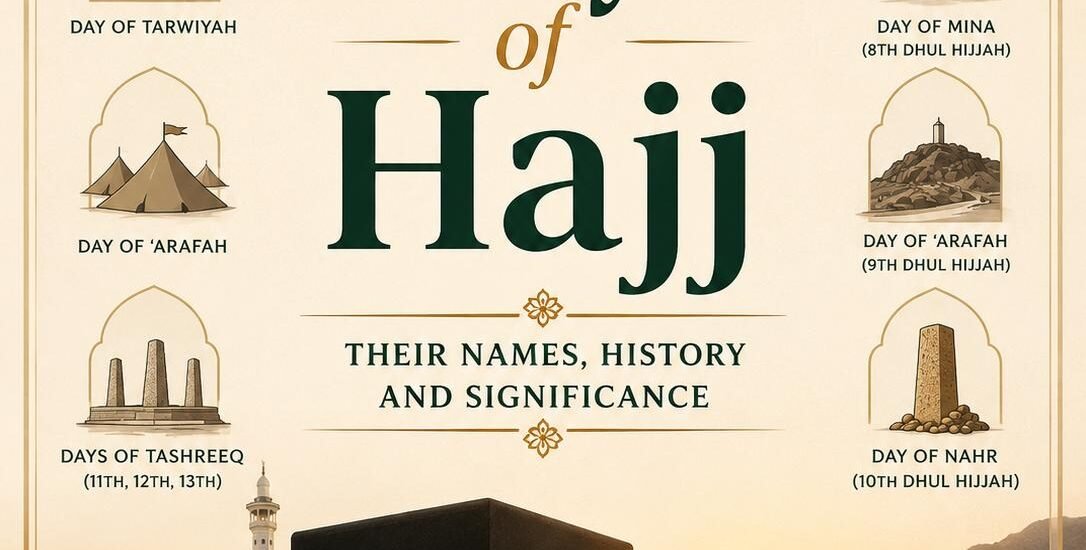
Their Names, History and Significance, —Habib Nooh
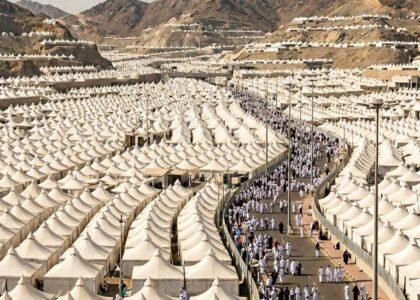
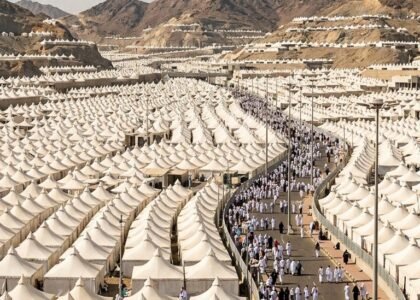
From tonight, the pilgrims will begin to take up their positions in Mina. The blessed days of Hajj are upon us — days whose very names carry within them the deep echoes of history, the immortal story of sacrifice, and the ineffable beauty of worship.
1. The Eighth of Dhul Hijjah — يوم التروية (Yawm al-Tarwiyah):
The name of this day holds two meanings, woven together as one.
The first meaning is the carrying of water. In earlier times, the people of Makkah would set out towards Mina on this day in preparation for Hajj, gathering sufficient water for the journey ahead. In the heart of the desert, water was life itself — and so this preparation was not merely practical,but essential.
The second meaning is to reflect, to ponder deeply. It is narrated that on this very day, the Prophet Ibrahim (AS) received, for the first time in a dream, the divine command to sacrifice his beloved son. Upon waking, he fell into profound contemplation —
was this truly a command from his Lord, or a whisper from elsewhere?”
It is the memory of that deep reflection which gives this day its name, Tarwiyah, to this day.
2. The Ninth of Dhul Hijjah — يوم عرفة (Yawm Arafah):
This is the most significant day of Hajj — indeed, one might say it is the very soul of Hajj.
On this day, millions of pilgrims gather upon the plain of Arafah. That vast ocean of humanity, draped in the white of Ihram — where there is no distinction between king and commoner, no divide between the wealthy and the poor — all standing with bowed heads before the One Allah.
The Messenger of Allah Sallallaahu Alaihi Wa Sallam declared: “Al-Hajju Arafah” — Hajj is Arafah. (Tirmidhi: 889, Ibn Majah: 3015)
The virtue of fasting on this day is beyond measure. The Prophet (PBUH) said: the fast of the Day of Arafah expiates the sins of two years — the year that has passed and the year to come. (Muslim: 1162)
3. The Tenth of Dhul Hijjah — يوم النحر (Yawm al-Nahr):
“Nahr” means sacrifice. This is the day of Eid ul-Adha — the day of Qurbani.
This day is the greatest day of the entire year. The Messenger of Allah (PBUH) said: “The most magnificent day in the sight of Allah is the Day of Sacrifice, followed by the days of Tashreeq.” (Abu Dawud: 1765)
On this day, the memory of the supreme sacrifice of the Prophet Ibrahim (AS) is brought gloriously to life — a sacrifice that was the answer to the most profound test in all of human history.
4. The Eleventh of Dhul Hijjah — يوم القرّ (Yawm al-Qarr):
“Qarr” means to remain still, to rest.
With the most demanding rites of Hajj now complete, the pilgrims remain peacefully in Mina on this day. Like the calm that settles after a storm — this is a day of rest for the soul. It is spent in worship, supplication, and the remembrance of Allah; a sacred pause amidst the intensity of these blessed days.
5. The Twelfth of Dhul Hijjah — يوم النفر الأول (Yawm al-Nafr al-Awwal):
“Nafr” means to depart. This is the day of the first departure.
Those pilgrims who wish to return promptly complete their stoning of the Jamarat on this day and take their leave from Mina. Allah the Almighty mentions this in the Holy Qur’an: “Whoever hastens to leave in two days, there is no sin upon him.” (Surah al-Baqarah: 203)
6. The Thirteenth of Dhul Hijjah — يوم النفر الثاني (Yawm al-Nafr al-Thani):
This is the day of the second departure — and the final day of the stay in Mina.
Those pilgrims who choose to remain one day longer, seeking the additional reward that comes with it, complete their stoning on this day before departing. With this, the formal rites of Hajj draw to a close.
7. The Days of Tashreeq — أيام التشريق (11th, 12th and 13th of Dhul Hijjah):
These three days are collectively known as Ayyam al-Tashreeq. The word “Tashreeq” refers to the drying of meat in the sun. In earlier times, pilgrims would preserve the meat of their Qurbani during these days by drying it under the sun, so that they might carry it with them on the long journey home.
These are days of joy, gratitude, and the remembrance of Allah. The Messenger of Allah (PBUH) said: “The days of Tashreeq are days of eating, drinking, and the remembrance of Allah.” (Muslim: 1141)